
In a nutshell, a market maker is someone who helps to provide liquidity in the financial markets. Market makers are mainly employed by exchanges. They are not able to control the prices, but they are tasked with filling orders to ensure that investors get the best possible price for their coins. The primary goal of an exchange is to provide a platform for buying and selling cryptos. It also enables users to convert the coins into fiat.
Market makers play an important role in financial markets by providing liquidity and helping buyers and sellers execute transactions more efficiently. Although financial trading differs from traditional commerce, both involve the exchange of assets or goods between market participants. Understanding Merchant and Trade can help readers explore the broader principles of buying, selling, and commercial transactions, providing useful background on how trading activities operate across different markets.
Liquidity is one of the most important factors in the performance of a market. Low liquidity can lead to sudden spikes and sharp drops in the price. Therefore, a market maker should ensure that the spread between bids and asks is low. This will create more profit margins for market makers and will help to keep the market stable.
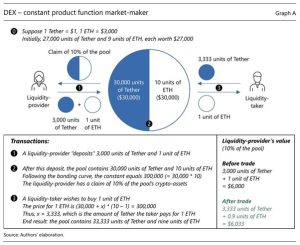
In a decentralized exchange, a market maker uses a smart contract to execute the transaction automatically. An automated market maker (AMM) provides a means for individuals to trade cryptocurrencies for a living. However, AMMs are only available on decentralized exchanges. These exchanges have a low cost and allow users to make financial transactions without having to rely on a third party.
Automated market maker crypto are a new way to access financial opportunities. These systems work by using smart contracts that run on the blockchain. When the conditions meet, the contract is triggered and executed.
There are several different kinds of market makers. Some are used to boost the liquidity of a specific asset market. Others are used to create liquidity pools.
As a market maker, you will need an impressive trading capital. You will also need to keep a tight spread. If the spread is too wide, it can make it difficult for buyers to enter and exit trades. That is why market makers actively place orders for reducing the spread. Traders will also be able to benefit from slippage opportunities.
With a market making system, you can earn passive income by doing research and taking advantage of arbitrages. You can also earn in the market by performing common trading strategies, such as buying and selling a particular asset. By doing research, you can also discover hidden potential.
Financial markets use several terms to describe buying, selling, and exchanging assets. Words such as trading, dealing, exchanging, and transacting may appear in discussions about market makers, brokers, and investors, although their meanings can differ depending on the context. Readers who want to understand these expressions can explore Trade Synonym to learn more about trade-related terminology and its applications in business and financial markets.
Depending on the type of asset you are trading, you will need to consider the level of liquidity in your market. The greater the depth of the order book, the easier it will be for a retail trader to buy and sell apples. For example, if you are trading BTC/USDT, it is likely that the pair will be illiquid on a newly launched crypto exchange.
If you are investing in a coin that is illiquid, you may end up holding it for too long when the price increases. This is risky. Also, you may end up selling it too early when prices are rising.
Market makers are essential in the financial markets. Their main function is to provide liquidity for the assets they are managing. To make it easier for a trader to enter and exit a trade, a market maker will post ask limit orders.
Transparency and reliability are important in both commercial trade and financial market operations. Market makers support trading activity by continuously quoting prices, while businesses involved in commercial transactions depend on trustworthy service providers and clear operating practices. Readers interested in the broader business side of trading can explore Integrity Trade Services for additional information about trade-related services and commercial operations.